My ramblin’ jones led me to Oklahoma last week. People who aren’t obsessive about music may find the concept of music tourism in a state sandwiched between Kansas and Texas laughable. Yet Oklahoma made a huge impact on American music in the 20th century. It’s still a hub for a distinctive, commercially viable sound.
Here’s a partial roll call of prominent Oklahomans: Garth Brooks, J.J. Cale, Charlie Christian, the Flaming Lips, the Gap Band, Woody Guthrie, Jay McShann, Jimmy Rushing, Leon Russell and Bob Wills. Today, hordes of homegrown red dirt country bands like Turnpike Troubadours play to big crowds across the country.
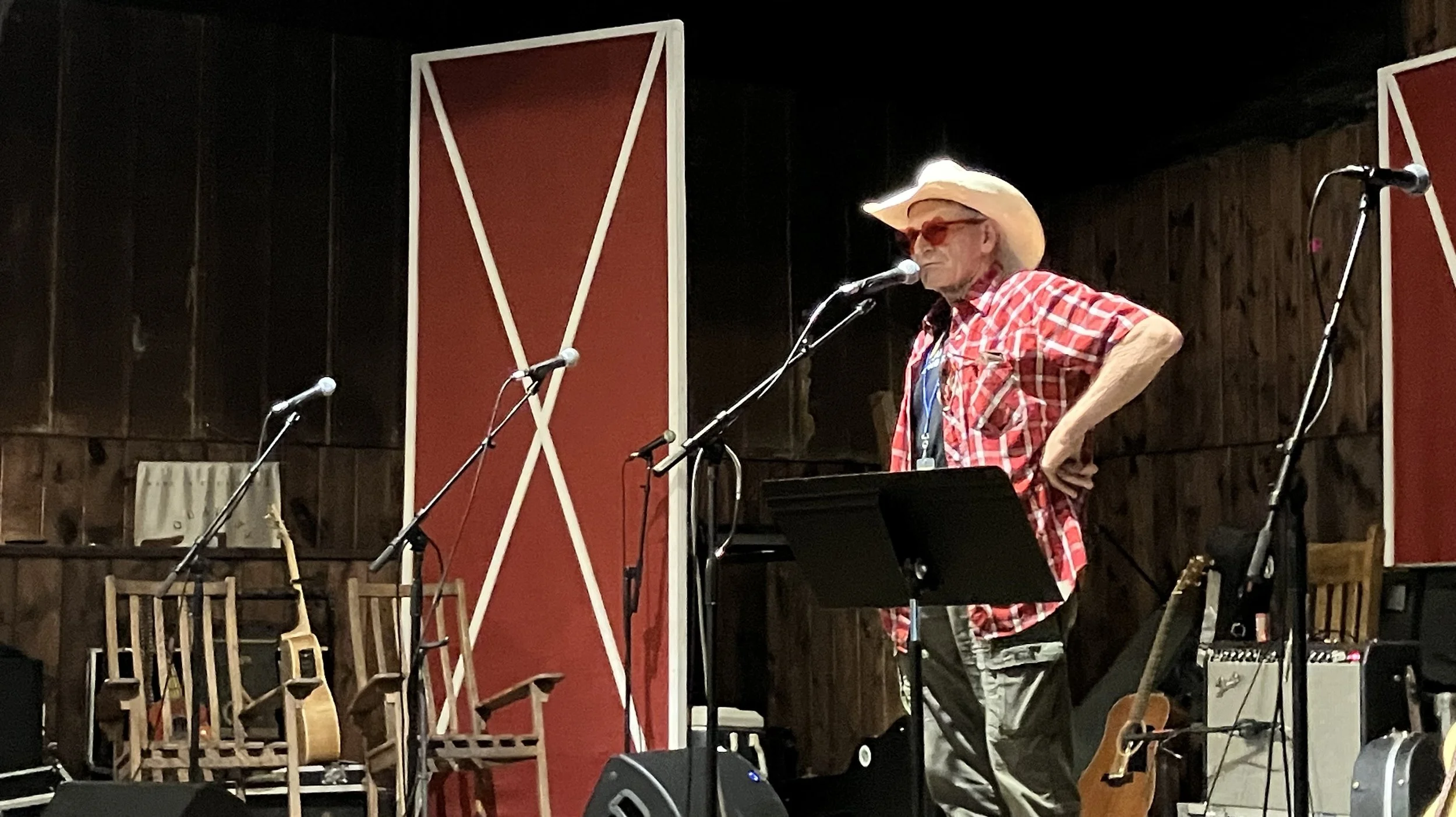
I wheeled my road trip around Butch Hancock’s 80th birthday celebration at Woody Fest in Okemah, Oklahoma. I hadn’t previously patronized the folk festival in Woody Guthrie’s hometown. Furthermore, I couldn’t recall attending a Hancock performance, although I surely did in the late ‘80s and/or early ‘90s.
If The Flatlanders were more a legend than a band, Hancock is more a rumor than a man. His music isn’t available on DSPs and he’s certainly not the social media type. Fortunately for me, plenty of Hancock’s music is available in the Museum of Dead People and Outmoded Formats located in my basement.
Even if I was disappointed that the songwriter remained seated as his colleagues performed their favorite Hancock compositions for most of the show, I was glad to have been present at the heartwarming event that concluded with Hancock’s reading of “If You Were a Bluebird.”
I was dismayed to discover the Guthrie homestead is a vacant lot while in Okemah. I also became a Bonnie Whitmore fan, finally “got” Aaron Lee Tasjan and was reduced to a puddle of tears upon hearing My Politic’s “Buzzards on a Powerline” for the first time. I’m still reeling.
Tulsa’s bustling earthiness reminds me of Austin, Texas, circa 1995. I became intimate with the streets in and around the pretty campus of the University of Tulsa and spent quality time at the verdant Gathering Place. The Bob Dylan Center and The Woody Guthrie Center are located on Reconciliation Way at the site of one of the United State’s most horrific atrocities.
The Dylan Center is filled with the sort of crucial relics that are curiously missing at the Guthrie Center. Yet the Okie’s museum is currently hosting the touring Hip-Hop America: The Mixtape Exhibit. It also featured a strident poetry reading and a separate performance of union songs associated with Joe Hill on the day of my visit. I miss the town already. Take me back to Tulsa.